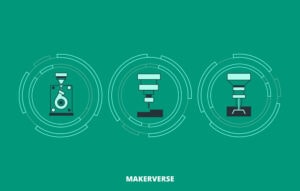
Industrial 3D Printing Technologies for Production Parts
Industrial 3D printing is additive manufacturing built for scale. Unlike desktop 3D printers, industrial systems deliver the build volume, engineering-grade materials, tight tolerances, and certification pathways that regulated industries demand. These machines don’t just create prototypes. They produce functional parts ready for aerospace cabins, medical devices, and automotive assemblies. The sections below break down the three main technology families: polymer powder-based, metal additive, and extrusion-based processes — each with distinct strengths for different production scenarios.

SLS, MJF, and SLA for Polymer Production Parts
Three technologies cover the majority of polymer production part needs. Each uses a fundamentally different printing process, which means the ideal choice depends on your tolerances, surface finish requirements, and batch production volume. MakerVerse offers all three from a single platform, so you don’t need to manage separate suppliers for different polymer processes.
Technology | Process Principle | Ideal Application | Achievable Tolerances | Surface Finish | Key Materials |
|---|---|---|---|---|---|
SLS | Laser sinters nylon powder layer by layer | Functional prototypes, small-series production | ±0.3 mm | Slightly grainy, good mechanical surface | PA12, PA11, PEEK |
MJF | Inkjet-based fusion (HP) with infrared energy | Batch production with fine detail and increased throughput | ±0.2 mm | Smooth, consistent across builds | PA12, PA11 |
SLA | UV laser cures liquid resin | High-resolution parts, biocompatible components | ±0.1 mm | Highest surface quality and detail | Engineering-grade and biocompatible resins |
Metal Additive Manufacturing: SLM, DMLS, and Binder Jetting
Metal additive manufacturing is the fastest-growing segment of industrial 3D printing, driven by aerospace and medical demand for complex, lightweight metal parts that traditional methods struggle to produce.
- SLM / DMLS (Laser Powder Bed Fusion): Fully melts metal powder using a high-energy laser. Produces dense, high-strength end-use parts from stainless steel, titanium (Ti6Al4V), Inconel, and aluminum (AlSi10Mg). Best suited for complex geometries in aerospace and medical applications. Apple’s adoption of LPBF for watch cases has validated this technology as capable of true mass production.
- Binder Jetting: Deposits a binding agent onto metal powder, then sinters the part in a furnace. Cost-effective for medium-volume metal parts with less demanding mechanical requirements. Stainless steel is the most common material. Per-part cost is lower than LPBF at higher volumes, making it ideal for scaling beyond prototyping.
Metal 3D printing typically costs $50–$500+ per part depending on complexity, material, and post-processing. For a deeper look at quality control options for metal additive manufacturing, MakerVerse provides access to production-grade metal parts through its platform.
FDM/FFF with Engineering-Grade Materials
Industrial fused filament fabrication is the right choice when build volume, specific thermoplastic properties, or high-temperature resistance matter more than surface finish. Large parts that would be prohibitively expensive with powder-based processes become accessible with FDM. Materials like ULTEM (PEI), carbon-fiber-reinforced nylon, PEEK, and other high-temperature polymers give engineers the ability to match demanding design requirements. Industrial FDM is typically the most cost-effective additive manufacturing process for larger functional parts.
Best-use cases for industrial FDM:
- Jigs, fixtures, and tooling aids for production lines
- Large-format functional prototypes that need real-world testing
- Parts requiring flame-retardant or chemically resistant materials
- Low-cost validation before committing to metal or powder-based production
Buy an Industrial 3D Printer or Outsource Production?
Here’s something most search results won’t tell you: the majority of top-ranking pages for “industrial 3D printing” are written by printer manufacturers. But many businesses searching this term don’t need to buy a machine. They need parts produced. The real decision isn’t which 3D printer to purchase. It’s whether owning one makes financial sense at all.
Factor | In-House Equipment | Outsourcing / On-Demand Platform |
|---|---|---|
Capital investment | $30,000–$150,000+ per system | Per-part pricing, no capital outlay |
Technology access | Limited to one or two technologies | Multiple technologies from one source |
Facility requirements | Ventilation, powder handling, safety modifications | No facility or staffing overhead |
Staffing | Skilled technicians and ongoing training | Quality managed by provider |
Scalability | Idle capacity during low-demand periods | Order 1 part or 500 on demand |
Speed for infrequent users | Setup and learning curve per project | Faster time-to-part with no ramp-up |
Below a certain annual volume threshold, outsourcing is typically more cost-effective than owning equipment. Platforms like MakerVerse, traditional service bureaus, and regional on-demand manufacturing networks all eliminate capital investment while providing access to multiple additive manufacturing technologies. MakerVerse specifically consolidates SLS, MJF, SLA, FDM, and LPBF into a single source, so businesses can scale production without managing separate suppliers. Use the MakerVerse Procurement Savings Calculator to estimate what consolidation could save your team.
5 Criteria for Evaluating an Industrial 3D Printing Service
Most comparison guides focus on technologies or materials, but rarely address how to evaluate the service provider behind them. Whether you’re outsourcing to a traditional service bureau, a regional manufacturing network, or a digital platform, these five criteria determine whether a provider can reliably deliver production-grade parts. This framework is built for procurement managers and engineers who need a structured way to compare multiple providers before committing to an order.

Technology Range and Material Portfolio
Complex projects rarely rely on a single printing process. You might need selective laser sintering for polymer housings and LPBF for metal brackets within the same project. A provider with a narrow technology range forces you to manage additional suppliers, adding coordination overhead and risk to every order.
Before selecting a provider, ask these questions:
- How many additive manufacturing technologies do they offer in-house or through their network?
- Does their material portfolio cover both engineering-grade polymers and metals?
- Can they handle multi-technology projects from a single order?
- Do they offer DfAM (Design for Additive Manufacturing) guidance to optimize your parts?
MakerVerse covers SLS, MJF, SLA, FDM, and LPBF from a single platform, combined with CNC and other manufacturing technologies for hybrid projects that span multiple process categories. The Manufacturing Advisor helps you identify the right technology and material for your specific application before you upload a file.
Quality Certifications and Part Repeatability
Certifications like ISO 9001, AS9100, and ISO 13485 signal that a provider follows documented quality management processes — but not every provider holds all of them directly. MakerVerse is ISO 9001-certified. For regulated industries like aerospace or medical, sector-specific certifications may be available through qualified manufacturing partners. Always verify which certifications apply to your specific order on the MakerVerse certifications page.
But certifications alone don’t tell the full story. The critical distinction is between one-off precision and true repeatability. Repeatability means producing the same part identically months apart. That’s what matters for production and spare parts. Quality doesn’t mean making the part better than the drawing. It means strict consistency: a part ordered today must be identical to one ordered three months from now. Achieving this requires mastering 3D printing tolerances across technologies.
Certifications to verify before placing an order:
- ISO 9001 – general quality management
- AS9100 – aerospace applications
- Material certificates and traceability documentation – essential for regulated industries
Lead Times, Pricing, and Instant Quoting
Traditional RFQ cycles create significant engineering downtime. A typical request-quote-review-requote cycle takes 10–14 days before production even starts. That’s two weeks of waiting with no parts moving. Instant quoting platforms compress this process to minutes, and transparent pricing with fixed delivery dates reduces procurement risk. No surprise cost adjustments after order placement.
Here’s how the two approaches compare in practice:
Factor | Traditional RFQ | On-Demand Platform (e.g., MakerVerse) |
|---|---|---|
Quoting time | 10–14 days | Minutes |
Production time | 3–6 weeks | 3–15 working days |
Total lead time | 4–8 weeks | 1–3 weeks |
Price certainty | Subject to revision | Binding quote upfront |
MakerVerse also offers a target price feature: if the instant quote exceeds your budget, users can submit a target price for manual review. This gives you the speed of automated quoting with the flexibility of negotiated pricing.
Industrial 3D Printing for Aerospace and Automotive
Each industry brings distinct regulatory, performance, and certification demands that directly shape which additive manufacturing provider can serve it. Choosing a service partner without verifying sector-specific capabilities creates risk long before the first part ships.
- Aerospace: 3D-printed metal parts can reduce component weight by up to 55%, translating into significant fuel savings. Boeing uses titanium AM parts in the 787 Dreamliner, and the Airbus A350 incorporates over 1,000 printed components. GE Aviation’s LEAP engine fuel nozzles remain the landmark example of regulatory-approved, serial-production additive manufacturing in aviation. For regulated aerospace applications, providers must demonstrate full material traceability and — where required — AS9100 compliance to satisfy FAA and EASA certification requirements. For projects with these requirements, verify whether your platform partner can source through AS9100-certified manufacturers.
- Automotive: Rapid prototyping and low-volume production tooling dominate automotive AM applications. Ford and BMW both use additive manufacturing to shorten design validation cycles and produce complex parts at annual volumes in the low thousands, where injection molding tooling costs aren’t justified. The economics favor AM for intricate geometries that traditional methods struggle to deliver efficiently. For a broader look at how the industry applies this technology, see MakerVerse’s guide to 3D printing in the automotive industry.
Material Selection for Functional Prototypes
The core advantage of prototype injection molding over 3D printing is the ability to test with the exact same material used in full-scale production. Your functional prototypes behave identically to production parts because they are made from the same resin, using the same process. However, material selection also directly impacts your prototype mold’s lifespan and your overall tooling budget. Abrasive materials wear aluminum molds significantly faster, so choosing the right resin early matters.
- ABS: Versatile, good impact resistance, ideal for housings and enclosures. Gentle on aluminum molds.
- PP (Polypropylene): Chemical resistance, living hinges. Low mold wear.
- PC (Polycarbonate): High-impact strength, optical clarity. Requires higher melt temperatures, which can affect mold longevity.
- PA (Nylon): Excellent mechanical properties for functional testing, but moisture-sensitive and must be dried before processing.
- TPU: Flexible, abrasion-resistant. Requires specific mold venting to avoid trapped gas.
- Glass-filled resins: Superior stiffness for high-performance plastic parts, but abrasive materials like these reduce aluminum mold life by 40–60 %. Consider testing with an unfilled substitute first, then validating with the glass-filled resin in a later iteration.
Always match your prototype material to the intended production resin. This is the only way to ensure valid functional testing and regulatory submissions. If your project requires an abrasive or high-heat resin, factor the reduced mold life into your tooling budget from the start.
Injection Molding Prototyping with MakerVerse: One Platform from Mold Design to Delivery
Managing separate suppliers for 3D printing, CNC machining, and injection molding means fragmented communication, inconsistent quality standards, and multiplied administrative overhead. Every additional vendor adds another quote to chase and another point of failure to monitor. MakerVerse eliminates that complexity as a single-source platform for your entire manufacturing project.
- Upload your CAD file (STEP recommended) to the MakerVerse platform.
- Receive a quote with a binding price and guaranteed delivery date, either instantly or through manual review.
- Production through a vetted, European-only supply chain.
- Quality inspection included – ISO 9001-certified processes ensure consistent part quality across repeat orders.
- Delivery with full traceability and a dedicated personal contact for every project.
For injection molding for prototyping projects specifically, MakerVerse offers fixed-price quotes without hidden costs. If the initial price exceeds your budget, the target price option lets you submit a desired price that the team checks for feasibility manually. You can also combine injection molding with CNC machining or 3D printing in a single project, keeping your entire development process under one roof.

MakerVerse: Instant Quotes and ISO 9001 Quality for Industrial 3D Printing
The five evaluation criteria above work as a checklist. MakerVerse is built to meet every one of them through a single platform. Instead of coordinating multiple service bureaus for different technologies, you upload a CAD file once and receive a binding quote within minutes.
- Technology range: SLS, MJF, SLA, FDM, and LPBF for additive manufacturing, plus CNC machining, injection molding, and additional manufacturing technologies – all accessible from one source.
- Quality: ISO 9001-certified production with strict consistency. The same part is produced identically whether ordered today or in three months. For sector-specific certification requirements, selected manufacturing partners cover additional standards – verify coverage on the certifications page.
- Lead times: Fixed delivery dates within 3–15 working days, stated upfront in every quote.
- Pricing: Transparent, binding quotes with no hidden costs. If the instant price exceeds your budget, submit a target price for manual review by the MakerVerse team.
- Supplier consolidation: One platform replaces multiple vendors. Upload your CAD file, select your technology and material, and receive a binding quote for the entire project. See how leading manufacturers like Siemens Energy use MakerVerse to streamline their parts sourcing.