


What’s the Difference? A Quick Process Overview
FDM, SLA, and SLS are all polymer additive manufacturing processes, but they work differently, produce different surface qualities, and suit different applications. Here is what you need to know before you decide.
FDM — Fused Deposition Modeling
A heated nozzle melts a thermoplastic filament and deposits it layer by layer onto the build platform. Each layer fuses to the one below as it cools. The result is a solid part built from stacked extrusion paths — fast, affordable, and available in a wide range of engineering-grade materials.
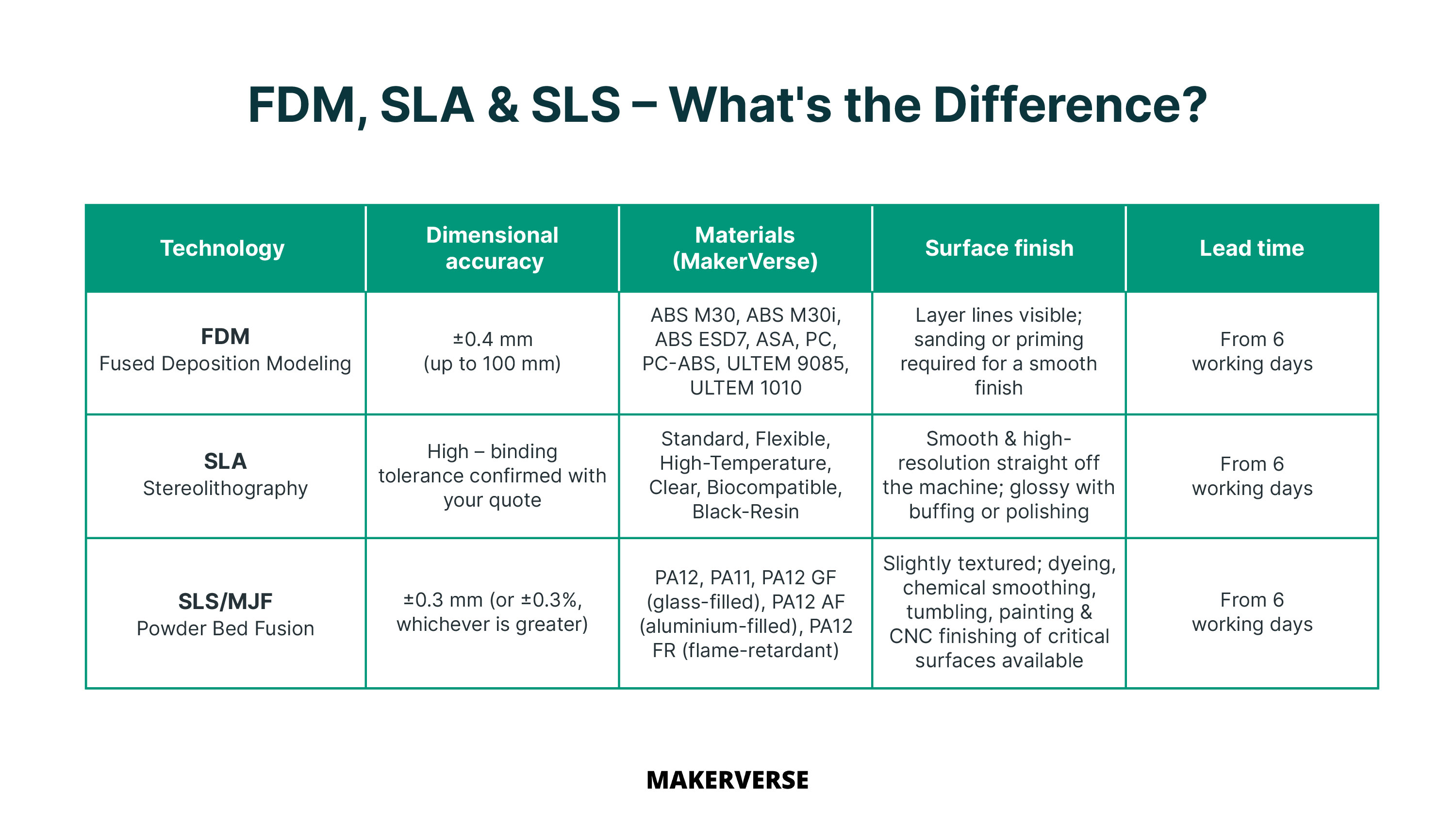
Dimensional accuracy: ±0.4 mm (up to 100 mm)
Max build volume: 914 × 610 × 914 mm
Materials (MakerVerse): ABS M30, ABS M30i, ABS ESD7, ASA, PC, PC-ABS, ULTEM 9085, ULTEM 1010
Surface finish: Layer lines visible; sanding or priming required for a smooth finish
Lead time: From 6 working days
In one sentence: fast and cost-effective for large, simple parts in engineering thermoplastics — visible layer lines are the trade-off. Stronger Prints: Best Practices for FDM 3D Printing
SLA — Stereolithography
A UV laser traces each cross-section of the part into a vat of liquid photopolymer resin, curing it solid one layer at a time. The build platform lifts as each layer sets, producing highly accurate parts with smooth surface finishes. Layer thickness typically ranges from 10 to 100 microns, which is what gives SLA its resolution advantage over FDM and SLS.
Dimensional accuracy: High — binding tolerance confirmed with your quote (not published as a fixed figure)
Materials (MakerVerse): Standard Resin, Flexible Resin, High-Temperature Resin, Transparent/Clear Resin, Biocompatible Resin, Black Resin
Surface finish: Smooth and high-resolution straight off the machine; glossy with buffing or polishing
Supports required: Yes — resin support structures, removed in post-processing
Lead time: From 6 working days
In one sentence: highest surface resolution and detail of the three — the go-to for visual prototypes, optical parts, and medical or dental models. Translucent Resin for SLA 3D Printing: Best Applications & Technical Guide
SLS — Selective Laser Sintering
A CO₂ laser sinters polymer powder — typically PA12 — in a powder bed, fusing particles into a solid cross-section layer by layer. The unsintered powder surrounding the part acts as a natural support structure. No separate supports are needed, which eliminates support removal time and cost and unlocks full design freedom for undercuts, internal channels, and snap-fit geometries.
Dimensional accuracy: ±0.3 mm (or ±0.3%, whichever is greater)
Max build volume: 700 × 380 × 580 mm
Materials (MakerVerse): PA12, PA11, PA12 GF (glass-filled), PA12 AF (aluminium-filled), PA12 FR (flame-retardant)
Surface finish: Slightly textured (media-blasted standard); dyeing, chemical smoothing, tumbling, painting, and CNC finishing of critical surfaces available
Lead time: From 6 working days
In one sentence: best process for complex functional parts — snap-fits, hinges, internal channels, small-batch runs — with no support structure constraints. Finishing SLS Parts: A Selective Laser Sintering (SLS) Guide
Now that you know how each process works, here’s how to decide which one fits your part.
Which Process Fits Your Part?
The right choice comes down to three variables: surface quality, geometry complexity, and whether the part needs to perform under load. Use the matrix below as a starting point, then read the use-case guidance underneath.
Criterion | FDM | SLA | SLS |
|---|---|---|---|
Surface finish | Layer lines visible | Smooth, high detail | Slightly textured (media-blasted standard) |
Dimensional accuracy | ±0.4 mm (up to 100 mm) | High — confirmed with quote | ±0.3 mm (up to 100 mm) |
Support structures | Yes (must be removed) | Yes (resin) | No |
Complex geometry / undercuts | Limited | Limited | Excellent |
Functional strength | Good — ABS M30, ASA, PC, ULTEM | Moderate — photopolymer resins are rigid but brittle | High — PA12 isotropic strength |
Best for volume | 1–10 units | 1–20 units | 1–50 units |
Relative cost (outsourced) | Lowest for simple parts | Mid | Mid–High; no support removal cost |
Choose FDM for large, simple parts in engineering thermoplastics where surface finish is secondary. Choose SLA when surface resolution is the priority: visual prototypes, medical models, and optical components. Choose SLS for functional parts with complex geometry — snap-fits, internal channels, small-batch PA12 runs — where no support structures are needed and isotropic strength matters.
What About Cost? The Outsourcing Reality Check
The assumption that FDM is always cheapest breaks down quickly when you’re outsourcing rather than printing in-house. Here’s why.
FDM is the lowest-cost option for large, geometrically simple parts — but support removal and post-processing add labor cost that doesn’t show up in the raw material price. For complex parts with overhangs, those support structures also increase material consumption and print time.
SLS has no support structures to remove, which makes it cost-competitive — or cheaper — for complex geometries. The powder is partially recyclable, batch utilization is high, and there is no post-processing labor for support removal. For small runs of functional components, SLS often comes out ahead of FDM on total cost once you account for support work.
SLA sits in the mid-range but can be the most cost-effective option for a single high-detail prototype where CNC machining would be far more expensive. The material cost per part is higher than FDM, but the surface quality means less finishing labor after the fact.
The practical answer: don’t guess. Upload your CAD file to MakerVerse and get binding instant quotes for all applicable processes side by side, with confirmed delivery dates, before committing to one. Explore all additive manufacturing services on MakerVerse.
How MakerVerse Makes the Decision Easier
Choosing between FDM, SLA, and SLS usually means calling three different suppliers, waiting for quotes that arrive at different times, and comparing numbers that weren’t built on the same assumptions. MakerVerse removes that friction.
Upload a CAD file (STEP or STL) along with your technical drawing. MakerVerse’s Technical Drawing Analyzer reads tolerances and GD&T callouts directly from the drawing — no manual re-entry of specs. You receive a binding instant quote across all applicable processes and materials, with a fixed delivery date included. All three polymer AM processes — FDM, SLA, and SLS — are available on a single platform, so you’re comparing like for like.
The platform connects to a network of 280+ materials and 30+ post-processing options across ISO 9001-certified manufacturing partners. Every part is inspected before dispatch — dimensional verification and visual quality check are included as standard.


